
- Intro
- Early History of Flax
- Flax in North America
- A Revival of Flax Production in North America
- Conclusion
- References
Intro
So why flax exactly? I’ve been asked this question more than once and honestly, my answer is usually pretty unsatisfactory, for both myself and the questioner, I’m sure. I’ve said things like, ‘Why not? We all have to do something, right?’ or ‘Because it’s fascinating and I happen to have the space to grow it.’ I mean, they aren’t terrible answers they just don’t fully answer the question. So, I am going to take some time to fully answer that question; for myself and anyone else who might be interested. This answer will stretch over several posts, so let’s start at the start.
Early History of Flax
Before domestication and the advent of agriculture, humans gathered the materials they needed from their surrounding landscape. And this included the materials they needed to clothe themselves and make other necessary textiles. According to an article written by Fibershed, “The oldest textile in the archaeological record—recovered from a 30,000-year-old Upper Paleolithic cave in the Republic of Georgia—is made of braided, knotted, and dyed fibers derived from wild flax (Linum bienne). Articles made of wild flax have also been found at 29,000-year-old Moravian archeological sites in the Czech Republic.” And once humans began the process of domestication, its usefulness and importance skyrocketed.
Common flax (Linum usitatissimum) has the honor of being considered one of the eight “founder crops” of agriculture. The other seven species are einkorn wheat, emmer wheat, barley, peas, chickpeas, lentils and bitter vetch. The “founder crop notion” suggests that these eight crops arose in the Fertile Crescent as a result of a focused and single process around 10,000 years before present. The crops were then spread outside the core area thanks to trade. These eight crops have traditionally been considered the earliest domesticated crops, however, there is a more recent disagreement about this founder theory. Many scholars these days theorize that domestication of agricultural crops began much earlier than 10,000 years ago, took place over thousands of years and was much more wide spread, in both area and plant varieties (meaning there was more than eight crops that should be considered “founders”). This is often referred to as the “protracted model”. Regardless of the who, what, where, and when of the matter, flax is one of the earliest fiber and oil crops, making it key to human civilization. And if you take away nothing else, it’s that flax has been an important part of our lives for way longer than it’s been forgotten about.
But where does common flax come from? I’m so glad you asked. Current evidence points to pale flax (Linum bienne) as the progenitor of our domesticated flax varieties. Pale flax is an annual, biennial or a short- lived perennial (I checked out three different sources on this and none explained the differences so if you happen to know why there are three different life spans please comment below!). It is quite similar in appearance to domesticated flax with narrow leaves and seed capsules. The differences include a more wiry stem, pale lilac flowers and dehiscent seed capsules (meaning the capsule will slit open to release mature seed). It tends to prefer south-facing slopes, relatively infertile and drought-prone soil such as dry grasslands, scrubby areas and cliff-slopes. You will find it flowering between May and September.
“The oldest textile in the archaeological record—recovered from a 30,000-year-old Upper Paleolithic cave in the Republic of Georgia—is made of braided, knotted, and dyed fibers derived from wild flax (Linum bienne).”
-Fibershed, “Weaving Cloth and Culture from Flax: Connecting Continents and Generations”

Flax in North America
The indigenous peoples of North American had been using wild flax species as sources for fiber for both textiles and cordage for thousands of years. But when Europeans began to settle the continent, they brought with them the tools, animals and seeds that they would need to be successful. In our case, they brought common flax seeds with them to ensure that they would have the raw material for spinning and weaving for both household and industrial needs. The flax industry was so vital to the early settlements that in 1640, the Massachusetts General Assembly passed an Act that encouraged family production of flax. Pennsylvania, Maryland, Virginia, and other states soon followed suit. On into the 1700’s, if families couldn’t grow their own flax, you would likely find that they owned looms, wheels and/or spindles to be employed int the process of spinning and weaving local flax.
By 1682 in Carolina, flax and linen made it on their State list of staple commodities which included other raw materials and textiles as silk, hides, wool, hemp, and cordage. The list also included some food stuff and building material like wine, oil honey, tobacco, and masts just to name a few. In 1748 Peter Kalm, an explorer and naturalist noted of a community named Raccoon in New Jersey, “The people spin and weave a great part of their every-day apparel and dye it in their houses. Flax is cultivated by many people and succeeds very well.”
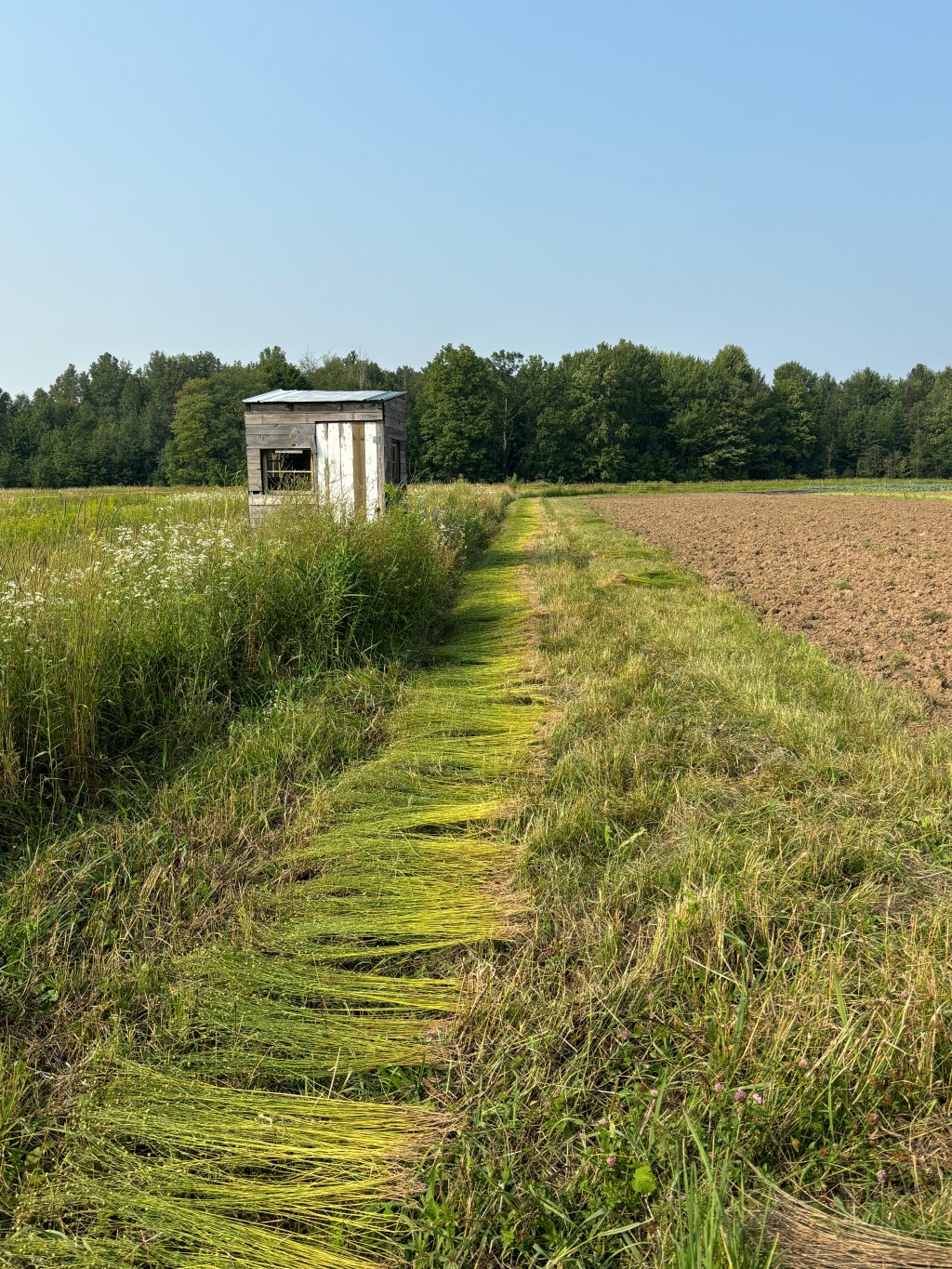
The slow march of industrialization beginning around the 1800s would ring the death toll for flax production in North America. With the invention of the cotton gin in 1794 and its validation in 1807, cotton became king. Through the combined use of enslaved African peoples and the cotton gin, cotton plantations ballooned in both size and quantity. Because cotton could be produced so cheaply, family farmers didn’t need to undertake the laborious task of growing and processing their own supply of linen. By the mid-1800s, flax production had disappeared across the board. It’s incredible to think that a plant that once held so much value in the domestic day to day that every family was involved in the process at some level, could be replaced so quickly. But I suppose that was the nature of the Industrial Revolution. Honestly having spent time hand processing my own flax (and they would have been using hand tools very similar to the ones I use), I understand why people jumped at the chance to use a cheap material they could buy. The time and labor that switch would have saved them would have been astounding. I understand why past generations willing gave up a heritage crop for something easier.
A Revival of Flax Production in North America
There has been a resurgence of interest in flax production and linen cloth in the recent years, thanks to the growing societal awareness of synthetic textiles and the harm the fast fashion industry is causing the planet. It’s an encouraging to witness the groups of people around North America that are diving into the challenge of reestablishing an industry around flax. Chico Flax, PA Flax Project, Fibrevolution and Taproot Fibre are just a few of the big names in North American flax right now. And thanks to the hard work of these and several other organizations and people, the North American Linen Association (NALA) was born. NALA is a nonprofit, grassroots association focused on rebuilding the seed-to-linen industry in North America through training and education, technical advice, networking, notifications about updates to industry standards and developments, and fostering collaboration between its members. I recently joined this association after months of imposter syndrome to because I wanted to support this group of people and benefit from their combined knowledge. The creation of this new association in North America is creating of buzz of excitement around the world. It really is an exciting time for flax, and if you agree you can donate to NALA here! By donating to NALA’s mission you will play a vital role in cultivating a greener future for our planet—one that honors our heritage while paving the way for innovative, eco-friendly textiles.
Conclusion
Flax has been a vital part of human history for thousands of years. Its’ uses are many and ever-evolving throughout its history. We think of it now as a rather expensive material for summer dresses or maybe curtains. But it used to be so much more. How far would ships have gotten without linen sails? Would Alexander the Great have gotten so far without the cheap, relatively light armor that linen helped make? And we don’t even know all the ways linen was used back in earlier periods since natural textiles are not easily preserved. In my opinion, flax remains a viable option for helping us combat synthetic clothing and the fast fashion industry. It’s been a part of us for millennia and it’s time to make it part of us again.
References
I just want to take a moment to thank all the blogs and articles I pulled information from to make this post come together! I hope you learned as much from the information gathered as I did 🙂
- https://wildseed.co.uk/product/species/wild-flowers/linum-bienne/
- https://cordis.europa.eu/article/id/442841-the-role-of-founder-species-before-agriculture
- https://www.thoughtco.com/founder-crops-origins-of-agriculture-171203
- https://www.naturespot.org/species/pale-flax
- https://courses.botany.wisc.edu/botany_400/Lab/LabWK03Fruitkey.html
- https://onlinelibrary.wiley.com/doi/full/10.1002/ece3.57
- https://fibershed.org/2024/07/16/cloth-flax/
- https://northamericanlinen.org/
- https://www.hellenicarmors.gr/en/armor/great-alexander-linothorax/
- https://en.wikipedia.org/wiki/Ancient_Greek_military_personal_equipment#:~:text=Linothorax%20armor%20made%20out%20of,such%20as%20a%20bell%20cuirass.



 Foxtail and Flax
Leave a comment